Wordsetc issue No. 6 is here | Featuring Imraan Coovadia
“Coovadia’s work hardly shies away from including troubling contemporary issues, including the inevitable twinning of race and political life in South Africa (and the myriad hues in which this link appears); the ambiguous position of Indians living outside of the Subcontinent – their ability to fit between the seams of discord, as well as irritate all sides of a given conflict; and the necessary criminal elements that help forge the bonds within such in-between societies, ensure survival for the time being, and foment plans of escape when necessary.” – M. Neelika Jayawardane
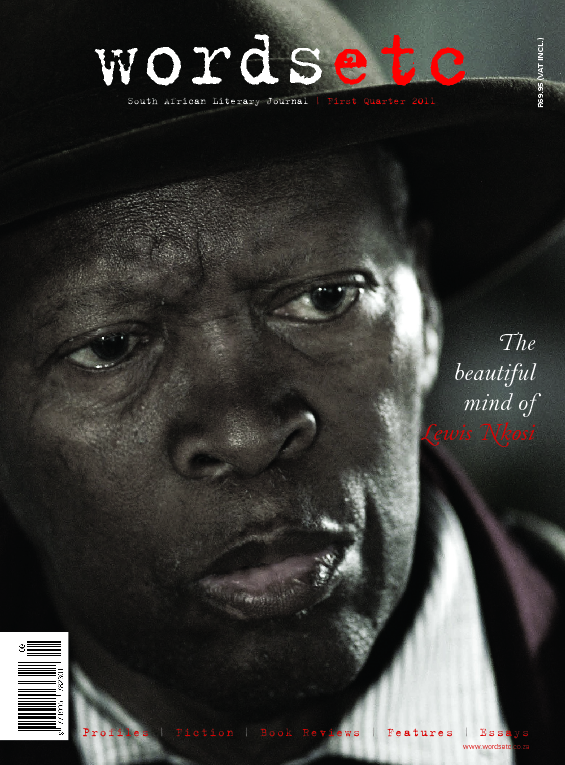
This sixth edition of Wordsetc, South Africa’s foremost literary journal, is out. Hot on the heels of a fantastic edition that looked at the iconic Nadine Gordimer, the latest edition continues to showcase the best of South African literature. It leads with novelist Imraan Coovadia, a young writer on a mission. He also teaches creative writing at the English Department at the University of Cape Town. He has just written his third book, High Low In-between.
We explore what makes him tick as a writer, the themes he explores, his literary influences and even the music he listens to.
The rest of the contents are also sizzling
- In the Personal Notes section, activist Zachie Achmat relives the days of his imprisonment at the age of 15 for political activism (“My Father’s Touch”). He has bittersweet memories of his father. A touching read.
- Over the years advertising icon Alistair King of King James Advertising has amassed a special collection of rare books. In an eloquent and humorous essay he tells why he frequents second-hand bookstores in search of that rare book (“The Collector”).
- Award-winning journalist Kevin Bloom tells us about motivation behind writing Ways of Staying, a book that takes an unflinching view at the state of the South Africa. Some may describe the book as bleak, but deep down, Kevin makes a case of being a realist (“The Realist”).
- Literary critic and writer Karina Magdalena Szczurek profiles seven of our top writers in South Africa. She specifically looks at how these writers hang on to their full-time jobs and still manage to write creatively (“Writers’ other lives”). A very illuminating feature.
- In the Appraisal section, researcher and academic Joy Watson offers a rich narrative about the legacy of Ruth First as a writer and champion of social change (“Her words”).
- For the past two years Victor Dlamini has been taking gorgeous photography of some of our remarkable artists, including writers. Across a spread of six pages, he shows readers his awesome work (“Capturing creative spirits”).
- In the How I Write section, acclaimed novelist Angelina Sithebe details how the writing business happens for her.
- Lindiwe Nkutha’s wonderful play called Woman In Transit is captivating in telling of a young woman from the countryside who comes to Johannesburg in the 1950s to find a city full of degradation, and her ultimate defiant stand against injustice. We publish an extract of the play.
- In our new Poetry section, Seni Seneviratne, an acclaimed poet and performance artist from Britain, tells us about the central role poetry plays in her life.
- In our Bookshelf Series, Absa’s marketing head Happy Ntshingila talks about the writing of his new book Black Jerusalem in which he reminisces about the heady days of crafting winning advertising pitches in his earlier life as a founding partner at Herdbouys advertising, the first black-owned advertising agency in the country.
There’s all this and more – literary travel, short story, book reviews, a restaurant review and listings pages. As with previous five editions, this issue is jam-packed. It will satisfy literature lovers and those keen to know more about the state of South African literature at the moment.
For an interview with publishing editor Phakama Mbonambi, or to excerpt any of the stories from Wordsetc such as below, please contact him on 083 287 1955 or flamencomail@gmail.com.
Editorial | A night to remember
Something wonderful happened this year at the Cape Town Book Fair, held at the International Convention Centre. Wordsetc shared a tiny stand with our dear friend Colleen Higgs, founder of Modjaji Books, a Cape Town-based women’s press. It was a small space, spare but cozy, perfectly befitting given the size of our respective operations. For three days we operated elbow to elbow, always on our feet: selling our respective operations, meeting old contributors, catching up with publishers and their publicists and just talking to whomever happened to show an interest. The fair started on a Saturday. By Tuesday, my head was reeling. I was in a state of grace, sure. But I was also dog-tired – my back ached from all the crating and lifting associated with these things, my feet hurt in my loafers, my head throbbed with the numbing effects of excessive exposure to the sound of my own voice.
Then into the frame of my vision walked a strikingly beautiful woman. She looked a little lost or maybe hesitant. She wore a beautiful black dress that accentuated her curves. She exuded style and grace. She could have been at a fashion show and not at a book fair. She approached. In a polished American accent, she introduced herself as Neelika Jayawardane. She had heard of Wordsetc, she said. In fact, a friend in Cape Town had raved to her about our little journal; she was so happy to meet the team and to find out more about our ongoing literary project. Instantly, our fatigue turned to ecstasy. We were over the moon.
Later that evening, we three from Wordsetc – your faithful founding editor, Zamani Xolo, our ever-cool creative director, and Sampo Mthanti, our able operations director – found ourselves across the hall from the book fair activities at Marimba restaurant. In the finest literary tradition, we opened a bottle of red wine and talked animatedly, getting to know each other. Neelika told us how she’d been born and bred in Sri Lanka, how later she moved to Zambia with her parents. Now she lived in New York, where, it turned out, as assistant professor in the English department of the State University of New York-Oswego, she lectures in literature. It further turned out that one of the writers she’s taught, one she knows well, one she really thinks highly of is …. Imraan Coovadia.
Hold on. Who?
You mean the guy we were planning to feature in our next edition?
Everyone howled. The literary gods be praised. We’d just found the perfect writer to profile this young South African writer whose stories, books and intellect have so beguiled us. As a cover story, Coovadia packs a lot of punch. Just read his three novels: The Wedding, Green-eyed Thieves and High Low In-between.
Two months later, sitting at my desk in Jo’burg, I opened an e-mail and there it was: the Coovadia profile from Neelika. It is a brilliant turn, looking inside the heart of a man and a writer – what motivates him to write, the themes that preoccupy him, his literary influences, even the music he listens to.
As you will read, Coovadia is a writer on a mission, perfectly suited to these pages. We at Wordsetc are also on a mission. We will carry boxes and stand until our feet hurt, we will stare out at our blank screens, we will babble on until we cannot babble any longer, and, hopefully, we will meet beautiful and intellectual people and be ever so enriched by the experience of their ideas and their work.
Phakama Mbonambi
Publishing editor
Personal notes | Zackie Achmat
The hands of a father will have many meanings for his children. They can touch us with care and love, or chastise us with pain. They can embody a coarseness or softness that goes beyond the categories of manual or mental labour, masculinity or femininity, weakness or strength. A father’s touch or its absence, with all its ambiguities, can live with us and beyond our time.
“The comrades expect you to write down the confession you gave to the Security Branch.” In December 1977, only Jean Naidoo, my first political mentor, had the authority to say these words to me. She was thirty-eight, only a year older than my mom. She also had six children. Since the age of fifteen, Jean had been involved in South Africa’s struggle for national liberation. In July 1977, she was sentenced to three months imprisonment because she refused to give evidence for the state against my friend, Azam Mohammed, and me. Our offence? We had set fire to our schools as a protest against racist education and out of frustration with students who returned to classes after the 1976 uprising.
Now Jean was asking me to confess again. Could I remember everything in the statement? Was I going to tell the comrades what I said? Would the comrades understand why I made that statement? Could I explain to them that the physical torture by Constable Dirk Vermeulen and the other one (I have repressed his name from my memory) had failed to produce a confession? Was there anyone who could understand the pain, the terror and the hate that produced that confession?
Jean died in 1982 and I never rewrote my confession, but I have thought about it every day since her request. I did not have to carry its burden alone. My father shared it. Since then he’d confessed to me, my friends, comrades, and to strangers whom I took home to Mitchells Plain to visit my family. He explained again and again that he had forced me to confess because of his fear of the Security Police.
After my release, every time I visited my father, he lit up a cigarette and then proceeded to light many more. The smoke hid his sadness, but he was compelled to speak, just as he’d forced me to speak. His speeches sought forgiveness. The cell at Sea Point Police Station, the interrogation rooms at Caledon Square and Gugulethu Police Station were images that remained fixed in his memory even as they receded from mine. My father could not forgive himself; he sought absolution from his son. Yet every assurance of forgiveness I gave encouraged fresh doubt in his mind. Memories of those fateful events imprisoned him.
I called him “Aboeja”, father. He explained over and over again that he’d feared the police would kill me. He did not want them to touch me, believing he could outsmart them. But in all his versions of this story, my confession – how and why I produced it – was repressed. It was the one part he could not tell then. Now, after thirty years, the memories and images return as I write this confession, an account of why I gave a statement to the police.
This story is for my father who struggled all his life with his disability, with his family, with trying to get an education and with his many demons which, in the end, included fundamentalist religion. This story is also for the beautiful things that made him my father – love of music, knowledge, learning and argument. He was a man who, after the years of restless searching for meaning and anger against his and our condition, learnt to express his love for my mother and all his children.
This story is also for Jean, and for the comrades who remained in detention after my release. It is for those who gave evidence against their comrades, and those who refused to comply and went to jail instead. But above all, this confession is for me.
It is not a talking cure. I always wanted to hold my father’s hand when he related his version of those events and say: “We were both there and we survived.”
...the complete article is found in issue No. 6 of Wordsetc.
Subscribe to Wordsetc now for only R170 for four editions.
If you would like to subscribe mail us on subscriptions@wordsetc.co.za.
The Wordsetc Magazine is also available at all Exclusive Books, CNA stores and at independent outlets such as The Book Lounge (Cape Town), Clarke’s Bookshop, Kalk Bay Books, Adams Books (Durban), White Cottage (Nottingham Road), Parkhurst Bookshop, Xarra Books (Newtown), Bookdealers of Melville, Bookdealers of Bryanston, Bookdealers of Rosebank and Protea Books (Hatfield, Pretoria).
Visit our Facebook group: Wordsetc – A South African Literary Journal
Appraisal | Her story
Ruth First and the written word as an agent for social transformation

On the afternoon of 17 August 1982, Ruth First, a feisty champion of social and political change, was in a particularly jovial mood in her office at Eduardo Mondlane University in Maputo, Mozambique, where she worked as Director of Research at the Centre for African Studies.
Ruth had just returned from shopping for a celebratory dinner that was to take place later that evening and was immersed in discussions on a conference on southern Africa, which she had helped organise. The conference had been a success and the dinner planned for later the evening was in honour of this.
Her comrade Pallo Jordan and an American colleague and friend, Bridget O’Laughlin, were with her at the time. They were joined by Aquino da Braganza, who was also employed by the university and to whom Ruth reported. He came into the room having collected his mail from his pigeonhole. Ruth then went to fetch her own mail and engaged in a jovial interchange with Aquino about her popularity and the amount of mail it generated, while standing by the window, sifting through her mail.
When she cut open a small parcel, a bomb was detonated and exploded so that the concrete ceiling cracked down the middle, a hole was torn in the wall and Ruth’s steel desk was split in two. She was killed instantly. The brutality of this act was so horrific that her remains had to be scraped off the wall afterwards.
One of the motivations for Ruth’s assassination by the apartheid regime can be attributed to the threat that she posed in her continuous publication of pieces of writing that subverted the authority and credibility of the apartheid state. Her readership was not confined to the borders of South Africa, but extended beyond into the African continent and the global arena.
The legacy of Ruth First
Ruth was an extraordinary woman, a revolutionary and a social activist who used the power of the written word to give effect to her agenda of bringing about radical social change to eliminate injustices perpetrated by the state in maintaining a system of white privilege and status.
She was an unconventional woman who made the contribution that she did at a time of significant gender imbalances in a society where it was far harder for women to pursue activist agendas. She was an exceptionally strong, intelligent and principled woman. She broke out of the societal mould of her time to be a non-conformist, unorthodox woman, one who made her mark and actively participated in a predominantly male-led liberation movement.
In reflecting on Ruth’s legacy and the contribution that she made to the national liberation movement through her written work, struggle stalwart Albie Sachs comments: “The encounter with her voice or with her written word releases in us, sentimentalists and non-sentimentalists alike, not only intense poignancy and anger, but also a sense of great pride and satisfaction of the kind she never permitted herself to feel in her manifold and lasting accomplishments. In the end, it is not the security police or the military, it is Ruth that comes again.”
At the Ruth First Memorial Lecture in 2000, her friend and comrade Jordan sought to name the contribution that she had made to the liberation movement in South Africa. He noted that she was “one of a talented corps of men and women, nationalists and Marxists, who initiated virtually all the major decisions that shaped the destiny of the liberation movement, and consequently, our country”.
He argued that her incisive, analytical mind would have greatly enriched the national debate both inside and outside the liberation movement and helped define a way forward for the country. He described her as a militant South African democrat and a Communist who became one of the foremost campaigners for the liberation of South Africa and other African states, both at home and during her years in exile.
In his book on the life of Thabo Mbeki, The Dream Deferred, Mark Gevisser writes that when Ruth’s daughter, Shawn Slovo, released a film about the life of her mother entitled A World Apart, Mbeki, President of South Africa at the time, expressed irritation and is reputed to have commented: “Why a film on Ruth? She spent 117 days in detention, yes, but why not a film about Albertina Sisulu?”
Comments such as these serve to seriously undermine the contribution of a brave woman who could easily have opted to live the relatively worry-free, privileged life that her whiteness entitled her to. Instead, she opted to take a vigorous stand for social justice, a stand that constantly brought danger onto the doorstep of both her and her family, and was eventually to lead to her ultimate demise. Her writing was an important tool in her endeavours in pursuit of these ideals.
During the time of her incarceration in 1963, Ruth wrote: “Several times a day I held a clean tissue in each hand to grip the bars in squeamish distaste at the grime thickly coating them, and I strained on my toes on the bedstead to see out of the window high in the wall. The figures rushing past could have been on celluloid film; they were not part of my world. The businessmen hurrying into the Danish restaurant opposite (I had eaten there myself in other times) spared an hour for their hors-d’oeuvres and poached trout, then bolted back to their desks, telephones and ticker tape. I was not hungry; I did not deny the diners their food, but I developed an antagonism towards those men in well-tailored suits who could bustle into the restaurant without turning their heads to the grilles in the grimy building opposite and whose complacency, I told myself, was a clear complicity.”
The above extract illustrates how Ruth’s sense of social conscience, and her need to actively be a part of transforming an unjust social order resulted in feelings of alienation and estrangement from a white middle-class social order that was skewed in favour of the interests of white men in particular. She felt ostracised from this world of unquestioned privilege, power and complicity, where men in business suits could go about their daily routines without questioning that their social privileges came at great expense to the black majority in the country.
...the complete article is found in issue No. 6 of Wordsetc.
Subscribe to Wordsetc now for only R170 for four editions.
If you would like to subscribe mail us on subscriptions@wordsetc.co.za.
The Wordsetc Magazine is also available at all Exclusive Books, CNA stores and at independent outlets such as The Book Lounge (Cape Town), Clarke’s Bookshop, Kalk Bay Books, Adams Books (Durban), White Cottage (Nottingham Road), Parkhurst Bookshop, Xarra Books (Newtown), Bookdealers of Melville, Bookdealers of Bryanston, Bookdealers of Rosebank and Protea Books (Hatfield, Pretoria).
Visit our Facebook group: Wordsetc – A South African Literary Journal
Master of ambiguity
Writer: M. Neelika Jayawardane
Imraan Coovadia’s latest novel, High Low In-between, is a double-murder mystery. The first to die is Arif – by a single gunshot wound to the head. A mere thirty-seven pages into the novel, Nafisa, his wife, and Shakeer (Sharky), his wayward photographer son, arrive to find him sprawled on the bed where Nafisa had left him prior to picking up their son from the Durban airport.
But there is a second death – accompanied by violence that is even more incomprehensible and a grief that is, perhaps, more vast. While classic crime novels draw to a close with clearly identified culprits, Coovadia’s intertwined second murder narrative unravels and bleeds out beyond final pages. The reasoning behind the causes for this death prove difficult to chain-link, and the culprits too shadowy to corner and hold to account.
The second “murder”, or, more accurately, the second set of deaths, are those of the tens of thousands – of the more than six million HIV-positive South Africans – whose immune systems and bodies have succumbed to the virus. While the mysterious circumstances surrounding Arif’s demise shape the course of the novel, the second death removes it from the realm of the typical crime narrative: it is the centripetal force whipping the characters – and readers – into an inescapable trajectory beyond their control.
Not once does Coovadia name the virus. Perhaps naming would make things too obvious. But his act of un-naming also alludes to the nation’s reluctance to do the same. We learn that Arif, before his death, had been consumed by his attempts to curtail the pseudoscientific expositions of a certain “Hansel Metzger”; he watched in dismay “as the government followed Metzger’s lead” and “derailed plans to manage the epidemic”.
When Sharky comprehends that the bullet that ended his father’s life was simply “the endpoint of a far longer process” – one that began when Arif directed his life onto a conduit that would bring him face to face with a national death – he realises that his father’s life had flooded out of “an exit far greater than a bullethole”. His life – and demise – simply play small roles in a national tragedy that continues to claim countless numbers. And before the end of the book, the invisible, but seemingly solid socio-economic and cultural barriers that separate the family from suffering the impact of this deadly wound, also disintegrate.
Coovadia’s first instinct was to use “Kaleidoscope” as the title: a broken mirror that distorts, changes, reconfigures things, and gives the viewer multiple scenes at once. He reveals that the “In-between” in his final choice reflects on the pendulum positions of “good cheer and pessimism” that South Africa goes through. “In-between” may also allude to the suspension in which the characters live, as well as the suspended and ambiguous nature of Indians in Africa.
Each character expresses the anxiety of waiting, suspended between being wounded and recognising the impact of that wound; many – Indian or not – live under a general fear of “body-invasion”: whether through legal manoeuvrings, fickle politics, physical violence or a virus.
Nafisa’s own strategy of dealing with various “invasions” is to employ a form of “witchcraft”, wherein she “postpone[s] comprehension”: Coovadia calls it the “sorcery” through which “life, love, and music” enter us, penetrating our psyches “before entering our understanding”.
...the complete article is found in issue No. 6 of Wordsetc.
Subscribe to Wordsetc now for only R170 for four editions.
If you would like to subscribe mail us on subscriptions@wordsetc.co.za.
The Wordsetc Magazine is also available at all Exclusive Books, CNA stores and at independent outlets such as The Book Lounge (Cape Town), Clarke’s Bookshop, Kalk Bay Books, Adams Books (Durban), White Cottage (Nottingham Road), Parkhurst Bookshop, Xarra Books (Newtown), Bookdealers of Melville, Bookdealers of Bryanston, Bookdealers of Rosebank and Protea Books (Hatfield, Pretoria).
Visit our Facebook group: Wordsetc – A South African Literary Journal
The Collector
Writer: Alistair King
I’ve made several attempts in my life to become a collector of some kind. When I was really young I started collecting bar coasters but abandoned it quickly when I realised I didn’t get around much. There were only so many hotels in (then) Rhodesia that were fancy enough to have bar coasters, so my collection stalled at around four, most of them for beer brands. So I started collecting coins. This went moderately well until my teenage years when my friends started making fun of me.
Apparently, coin collecting is one notch higher than stamp collecting on the geek scale, so I gave it up quickly to save what little street cred I had at the time. My love of chess hadn’t helped much in that regard either. When I entered university, I tried collecting girlfriends but that too failed miserably. I turned out to be, what is politely referred to as, a late bloomer.
I eventually realised I had become a collector without me really even noticing. It was a collection I had been growing for several years, slowly and incrementally, one purchase at a time. In my early teen years reading had become my passion and books had started to become genuinely precious objects to me. Even if the book I had read had turned out to be dull, I found that simply owning it gave me a certain satisfaction.
I remember the exact moment I fell in love with books. I was at a dusty second-hand bookstore in Parkview, Johannesburg. Tucked away between a bunch of raunchy novels were two maroon hardcover books that looked really old to my untrained eyes. As it turned out, they weren’t that old at all, but they had rough, serrated edges to the pages as if they had been cut by a blunt guillotine. That really impressed me, so I bought them just because I liked the way they looked. Not counting my Tiger and Beano annuals, they were the first books I ever bought with my own money and I still own them today; Sanctuary and The Sound and the Fury by William Faulkner. They are, of course, worthless (no dust covers), but their purchase set in motion a lifetime appreciation for books that appeared to have more of a story than the story printed on their pages.
For the next few decades I would do what most book lovers do: I bought and read books at my leisure, then stacked them on my bookshelf for display. But it would be many years before I could afford to tackle rare book collecting with any real purpose: there are cheaper hobbies, I can assure you. I don’t claim to be an expert or possess a huge or rare collection at this stage, but I am hooked and am steadily building my collection.
...the complete article is found in issue No. 6 of Wordsetc.
Subscribe to Wordsetc now for only R170 for four editions.
If you would like to subscribe mail us on subscriptions@wordsetc.co.za.
The Wordsetc Magazine is also available at all Exclusive Books, CNA stores and at independent outlets such as The Book Lounge (Cape Town), Clarke’s Bookshop, Kalk Bay Books, Adams Books (Durban), White Cottage (Nottingham Road), Parkhurst Bookshop, Xarra Books (Newtown), Bookdealers of Melville, Bookdealers of Bryanston, Bookdealers of Rosebank and Protea Books (Hatfield, Pretoria).
Visit our Facebook group: Wordsetc – A South African Literary Journal
Letters
Just to clear the air
I read Helen Moffett’s article on editing with interest (“The neglected art and craft of editing”) in your last edition of Wordsetc. Although I agree with many of her points, as I am a publisher at a local publishing house and therefore by definition a contributor to the apparently parlous state of local editing, I cannot agree with them all. I am happy, for instance, to correct her statement that “publishing staff are not ever paid for working overtime”: Oxford University Press does now pay editorial staff for agreed overtime, and this has resulted in some handsome cheques going home with tired staff members. It has also resulted, I think, in less overtime being worked – and this too is a good thing. While there are other points on which my opinions differ with Helen’s, I would like to focus on one omission. The main characters in Helen’s piece are editors (whether freelance or in-house) and publishers, with walk-on roles for finance villains and the like. Authors get a look-in too, but a glancing one. In my limited experience with publishing fiction, authors can, however, play a very significant role in determining what percentage of a publisher’s or editor’s good ideas for improvements are actually implemented. While some authors are wise and realise that an editor’s ultimate goal is to make the author look good and their book sell well, others unfortunately do not, fighting tooth and nail all the way – sometimes to their book’s detriment.
While it may be a publisher’s prerogative to edit the manuscript, to do so in the face of constant resistance and argument is another matter. It takes an iron will, an ability to shrug off abuse and a great deal of time – a combination that few publishers I have met possess (the last item is in especially short supply).
Editing, and in fact publishing, as Helen suggests, is not an industry for those who want the bright lights. It is a behind-the-scenes job, and most of the time it has to stay that way. When I read the programme for the Franschoek Literary Festival, I smiled at seeing a session on the industry’s best editors: the editors that I immediately think of as the industry’s best are mainly textbook editors and I know they will never get a mention at this type of event – textbook editing is the unglamorous end of an unglamorous industry.
But these are the people who can take an average manuscript (or one written at a furious pace because of unspeakable deadlines set by departments of education) and turn it into something that is illuminating, carefully scaffolded and written in language that a learner will grasp at once rather than struggle with – while still being curriculum-compliant, outcomes-driven, appropriately illustrated and glossed, and typo-free! Hooray for these editors and all the rest doing their invisible work well. My reading pleasure, and many learners’ experience of learning, relies on them.
Megan Hall
Publishing Manager: Dictonaries, School Literature in English,
Trade
Oxford University Press Southern Africa
Cape Town
Great discovery
I was introduced to Wordsetc when I bumped into the journal’s publishing editor at the Cape Town Book Fair this year. He recognised me from my previous incarnation as an (institutional) academic – he was one of my students when I lectured Sociology at Rhodes University in Grahamstown.
Having started anew as an artist, writer and freelance academic, I read with interest Helen Moffett’s piece on the woes of freelance editing (first quarter 2009). While the article was too long (she had said what she wanted to say in the first two pages), she is right that editors are underpaid and undervalued. A bit like academics – I was once offered four hundred rands to be an external examiner for a PhD thesis!
I am very pleased to have discovered a literary journal that provides an outlet for new and established writers and hope to make a contribution in future.
Dr Susan C. Ziehl
West Beach
Wonderfully varied content
I enjoyed the last edition of Wordsetc tremendously. It was varied, the articles were all quite different and yet each interesting in their own way. I know it’s a cliché, but I read it from cover to cover. I think it’s the best edition yet.
I really enjoyed the scope of the essays. Tim Keegan’s piece on Nadine Gordimer (“A life of letters”) brought back many memories. I first read and studied her work at Wits University while studying English and African literature and I found his appreciation spot-on. Reading Gordimer helped to liberate my own writing.
On another note, Janet van Eeden’s review of the Midlands restaurant La Lampara (“A taste of Italy”) in the lifestyle section also brought back so many memories. One of my distinctive early restaurant recollections is of having a spaghetti bolognaise at La Lampara at age nine in the 1980s. We lived in Norwood and this was one of my first meals at a “real” restaurant. I found Van Eeden’s piece wonderfully evocative – restaurant writing is hard to do.
I also loved Petina Gappah’s piece on growing up in Zimbabwe (“A beacon of possibility”), and the review of her book you carried makes me want to read her collection. Also impressive were Jeanne Hromnik’s touching article on her relationship with her gardener (“I’m Elliot”) and Helen Moffett’s sharp insights into the book editing process which provides food for thought.
Andre Brink’s thoughts on writing a story of slavery (“The jump into darkness”) made for fascinating reading, as did Nthikeng Mohlele’s essay on the writing life (“The third eye of the sixth sense”). Mohlele hits the nail on the head with the view that writers must make friends with poverty and says: “It is hard enough raising a single child, but an average story has at least ten characters, some of whom own dogs, harbour weighty secrets, are aggrieved, or unbeknown to them, face untold tragedy with every breath they take.”
I also can’t thank you enough for carrying such a generous selection of local book reviews, at a time when other media are cutting down on book reviews, not upping their book reviewing content. Instead, Wordsetc recognises the need to review books and thus adds an important series of voices to the renaissance that is taking place among local literature.
Arja Salafranca
Johannesburg
Thank you for Gordimer
As people who read relentlessly, from Tolstoy to cereal boxes, we always knew that there was something missing on the publishing scene. Lacking the courage, we could only hope that someone else will bring it forth. Someone did, and it’s with the gushing love of a long-awaited child that we revere Wordsetc.
Lending a book to someone, even your best friend, is difficult. Returning a book, however, is more heartbreaking: a borrowed friendship, can it, should it, be ever returned? I was borrowed Wordsetc. I risked ruining a life-long friendship and pretended I had returned it when, in fact, it was still in my handbag and had begun to assume the shape of the bag itself.
The issue in question was “Women & Words”. As a young South African woman, burdened with the misfortune of an education that relegated to the periphery African authors, let alone women authors, how do you go about acquainting yourself with the African literary landscape? Shots taken in the dark. You scour the internet, the papers, shamelessly eavesdrop on conversations and hope for the best. But the above-mentioned edition was revelatory and provided the heretofore absent candle and compass about women writing Africa and beyond.
In the same light, Nadine Gordimer on the cover of your last issue is exquisite. It further carries the torch lit by “Women & Words”. Both Gordimer and her works are famously not for the faint-hearted, yet Tim Keegan’s article brings her home. I endeavour to go out and seek her work. In addition, Dr Mongane Wally Serote’s comment in the same main profile is an indictment on all of us, the media and local readers, for lacking the appreciation for Gordimer. It’s a comment that should not be taken lightly.
Please keep up the critical work on a very suave and intelligent journal. The essays are brilliant. I thoroughly enjoyed “My beloved boozers” by Brian McDonald. Helen Moffett’s feature on editing was incisive and right on time. And, oh, I live for the book reviews! You can never have too many.
Matau Setshase
Pretoria
Write to us at Wordsetc.
If you would like to send us you letters you can email us on letters@wordsetc.co.za.
Visit our Facebook group: Wordsetc – A South African Literary Journal